The Rajasthan government will soon begin an online auction of a special pink sandstone variety, much sought after by builders including those constructing the Ram temple in Ayodhya, found in the Bansi Paharpur area of Bharatpur.
A standing committee of the Rajasthan Wildlife Board's has cleared a proposal to allow the mining of a special sandstone, much sought after by builders including those constructing the Ram temple in Ayodhya, from Bharatpur's Bandh Baretha sanctuary.
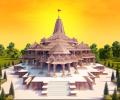
The construction of the Ram temple structure in Ayodhya will be done using Pink stone sourced from Rajasthan, and the temple campus will include a museum, research centre, 'gaushala' and a 'yagya shala', sources in the temple trust said on Thursday.
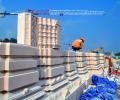
Work on building a pilgrimage facilitation centre and other utilities in Ayodhya's Ram temple complex has started, with 'darshan' of Ram Lalla expected to open in December 2023, according to a senior official of the construction committee.
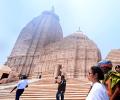
Built on around 24 acres of land using red sandstone quarried from Bansi Paharpur in Rajasthan, the Jagannath Temple at Digha, also known as Jagannath Dham, is an "architectural marvel, a mixture of intricate carvings and traditional design," an official said.
Mishra cited a shortage of around 200 workers and the need to replace certain stones on the temple's first floor as primary reasons for the delay.
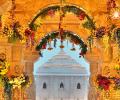
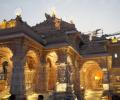
A new landmark of India -- both structural and spiritual -- rises on Ayodhya's horizon on Monday as a new-age architectural marvel of elegant sandstones, diligently carved by craftspeople with dedication and devotion to Lord Ram.
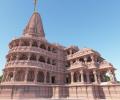
The ground floor of the three-storey Ram temple in Ayodhya is in its final stages and the work on ancillary structures is going on in full swing for their completion by October this year, the temple authorities said on Monday.

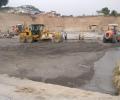
The foundation for the temple has now been filled with the final, 48th layer of roller-compacted concrete, temple trust members told reporters on Thursday.

The third phase of the construction of the Ram temple began at Ramjanmabhoomi in Ayodhya on January 24 with the laying of the granite stones for the plinth.

'The temple's construction is the result of collective wisdom of some of the best brains in the country. Water and sacred soil from almost all pilgrimage sites in India, including Gangotri, Yamunotri, Kailash Mansarovar, Prayags (there are seven Prayags) and all 'puris' (seven holy towns in India, besides Ayodhya) have been used in the making of the temple'
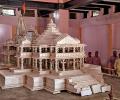
Chandrakant Sompura has either planned, designed, built or renovated over a hundred temples in India and abroad.
